

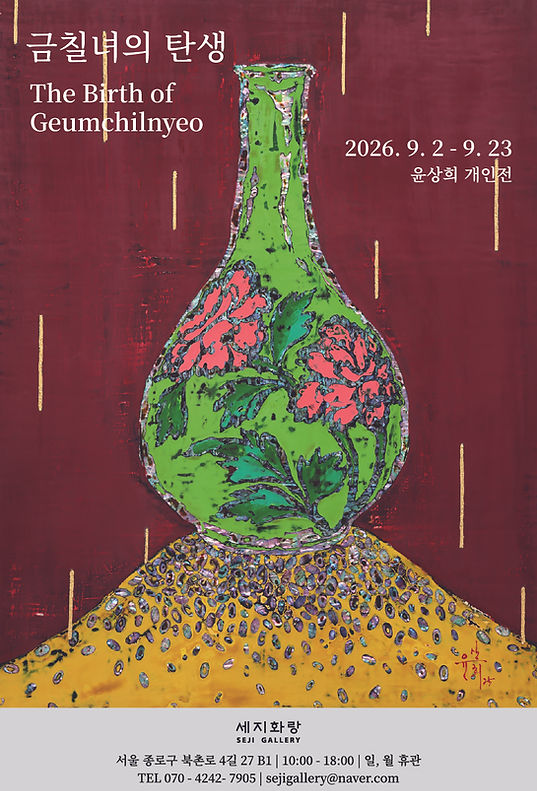
《금칠녀의 탄생》
《The Birth of Geumchilnyeo》
윤상희 개인전 Yun Sanghyui Solo Exhibition
2026년 9월 1일 (수) - 9월 23일 (수)
Sep 1st - Sep 25th, 2026
신표현적 옻칠, 종합주의적 세계관
안현정 (미술평론가·예술철학박사·성균관대학교박물관 학예실장)
윤상희의 신작을 가장 먼저 규정하는 것은 종합주의적 사유와 에너지이다. 평면과 입체, 회화와 공예, 전통과 동시대미술, 장인적 노동과 순간의 직관은 서로 다른 영역에 머물지 않는다. 윤상희는 지난 20여 년 동안 축적해온 금속·판화·장신구·옻칠·자개·오브제의 경험을 하나의 장으로 불러들이고, 건칠과 디지털 제작까지 교차시키며 자신의 조형적 질서로 재구성한다. 중요한 것은 장르의 혼합보다 서로 다른 물질과 시간, 기억을 하나의 작가적 필연성으로 조직하는 힘이다. 입체주의가 복수의 시점을 통해 대상을 새롭게 구축했다면, 윤상희는 복수의 물질과 시간, 기술과 경험을 다층적으로 포개어 하나의 조형적 장을 세운다. 이러한 태도를 나는 ‘종합주의로서의 옻칠’이라 부르고자 한다.
윤상희에게 옻칠은 시간을 생략할 수 없는 물질이다. 칠하고 건조하고 연마하며 다시 기다리는 반복 속에서 표면의 깊이가 형성된다. 2007년 ‘방어’의 개념을 담은 장신구에서 시작한 작업은 여성의 몸과 정체성, 관계와 치유의 문제로 이어졌다. 2013년 〈오브제 마임〉과 합(盒)에서는 안과 밖, 감춤과 드러냄, 쓰임과 관계가 서로 맞물렸고, 2018년 무렵에는 트라우마와 카타르시스, 인내와 자기 극복의 문제로 범위를 넓혔다. 옻칠의 반복적 공정은 상처를 지우기보다 덮고 갈아내며 다시 층을 쌓는 기억의 방식과 닮았다. 완성된 표면 아래에는 지나온 시간이 사라지지 않은 채 축적되어 있다.
이러한 시간의 축적 위에서 윤상희의 최근 작업은 ‘신표현적 옻칠’이라는 새로운 언어를 얻는다. 이는 거칠고 즉흥적인 표면을 의미하지 않는다. 오랜 숙련 이후 획득한 자유, 규칙을 몸에 익힌 뒤 비로소 가능해진 직관의 힘을 뜻한다. 젊은 시절 판화에서 경험한 ‘노동+에너지+결과물’과 독일 신표현주의에서 감지한 표현의 강도는 옻칠의 느린 시간과 다시 만난다. 전통 건칠과 3D 프린팅의 결합도 같은 맥락에 있다. 빠르게 제작한 디지털 골격 위에 다시 칠과 건조, 연마라는 손의 시간이 축적된다. 자연 재료와 산업 소재, 손과 기계, 전통과 기술은 서로를 지우지 않고 긴장을 유지한다. 공예의 본질과 동시대의 서사가 만나는 자리에서 신표현적 옻칠이 출현한다.
이러한 관계는 기(氣)와 리(理)의 긴장으로도 읽을 수 있다. 기가 순간의 직관과 충동, 표현의 에너지라면 리는 수십 년간 몸으로 익힌 공정과 질서, 장인정신에 상응한다. 윤상희의 힘은 둘 중 하나를 선택하는 데 있지 않다. 숙련만 남으면 기술은 자기 반복에 머물고, 직관만 남으면 표현은 순간의 충동으로 흩어진다. 축적된 질서 위에서 직관이 자유롭게 움직일 때 ‘완성도 높은 옻칠의 어제’와 ‘표현적으로 확장하는 오늘’이 연결된다.
그 정점에 《금칠녀의 탄생》이 놓인다. 금칠녀에는 어머니의 금은방에서 시작한 금속과 장신구의 기억, 여성의 몸과 자기 인식, 관계와 치유, 옻칠의 노동과 자개의 빛이 중첩된다. ‘말 잘 듣는 마마걸’이라는 기억을 거쳐 어머니를 바라보던 시선을 자신에게 되돌린 작가는 이제 자신의 삶과 욕망을 다시 읽는다. 금칠녀는 장식적 여성상이 아니라 축적된 시간을 새로운 힘으로 바꾸는 생성 중인 주체이다.
반복해서 등장하는 알은 이러한 자기 탄생을 압축한다. 초기 ‘방어’의 껍질이 외부로부터 자신을 지키는 경계였다면, 최근의 알은 새로운 존재가 세계로 나아가기 위해 통과하는 탄생의 막이다. 알에서 꽃으로, 꽃에서 기물과 우주로 이어지는 이미지는 순환을 넘어 새로운 관계의 발생을 보여준다. 빛에 따라 끊임없이 다른 색을 드러내는 자개, 반복되는 모자이크와 그리드 역시 고정된 본질보다 관계 속에서 변화하는 주체를 상징한다. 개별 요소들이 접속하며 이전에 없던 질서를 만들어내는 이 구조를 ‘창발의 네트워크’라 부를 수 있다.
결국 윤상희의 작업은 하나의 질문으로 모인다. 나는 누구이며, 무엇을 하는가.답은 선언보다 행위에 있다. 반복하여 칠하고, 기다리고, 갈아내고, 다시 쌓는 것. 지난 기억과 기술을 지우지 않고 새롭게 배열하며 서로 다른 물질과 시간 사이에서 아직 존재하지 않았던 관계를 만들어내는 것이다. 윤상희에게 종합주의는 바로 이러한 자기 구축의 방식이다. 공예의 본질과 동시대의 서사가 만나 ‘신표현적 옻칠’을 낳고, 서로 다른 주체와 물질, 기술이 관계 속에서 새로운 질서를 생성할 때 ‘창발의 네트워크’가 열린다. 《금칠녀의 탄생》은 그 두 움직임이 가장 밀도 높게 교차하는 지금의 윤상희를 보여준다.
Yoon Sanghee: Neo-Expressive Ottchil and a Syncretic Worldview
Ahn Hyunjung
Art Critic and PhD in Philosophy of Art
Chief Curator, Sungkyunkwan University Museum
What most distinctly defines Yoon Sanghee’s recent work is the energy of a syncretic imagination. Two and three dimensions, painting and craft, tradition and contemporary art, the discipline of craftsmanship and the immediacy of intuition no longer occupy separate territories. Drawing upon more than two decades of experience across metalwork, printmaking, jewelry, ottchil, mother-of-pearl, and object making, Yoon brings these practices into a shared field, extending them further through the intersection of traditional dry lacquer techniques and digital fabrication. Yet what matters here is not hybridity for its own sake. It is her capacity to bring disparate materials, temporalities, and memories into a compelling artistic order.
If Cubism reconstructed the object through the simultaneity of multiple viewpoints, Yoon constructs her own formal field through the superimposition of multiple materials and temporalities, technologies and lived experiences. These elements are neither simply juxtaposed nor dissolved into one another. Instead, they retain their differences while entering into new relationships. It is this approach that I propose to call “ottchil as syncretism.”
For Yoon, ottchil is a material inseparable from time. Its duration cannot be compressed or bypassed. Lacquer is applied, left to dry, polished, applied again, and allowed to rest. Through this cycle of labor and waiting, depth gradually gathers upon the surface.
Her practice began in 2007 with jewelry exploring the idea of “defense,” and from there expanded toward questions of the female body and identity, relationships, and healing. In the 2013 Objet Mime series and her lidded vessels, inside and outside, concealment and revelation, function and relationship became interdependent. By around 2018, these concerns had broadened to encompass trauma and catharsis, endurance, and self-transcendence.
The repetitive process of ottchil bears a striking resemblance to the workings of memory itself. A wound is not simply erased. It is covered, abraded, revisited, and layered over again. Beneath the apparent completeness of the finished surface, the time that has passed remains present, accumulated within its depth.
It is upon this sedimentation of time that Yoon’s recent practice arrives at a new language: “Neo-Expressive Ottchil.”
The term should not be mistaken for an aesthetic of roughness or spontaneous gesture. Rather, it describes a freedom made possible by mastery, an intuitive force that emerges only after discipline has been absorbed so thoroughly that it becomes embodied knowledge. The equation of “labor + energy + outcome” that Yoon encountered through printmaking in her youth, together with the intensity of expression she discovered in German Neo-Expressionism, now converges with the radically slower temporality of ottchil.
Her integration of traditional dry lacquer with 3D printing belongs to the same conceptual trajectory. A digitally fabricated structure may be produced with relative speed, but upon that structure the time of the hand begins again. Lacquer is applied, dried, polished, and layered repeatedly. The natural and the industrial, hand and machine, tradition and technology neither assimilate nor negate one another. They remain in productive tension.
It is precisely at this intersection, where the material intelligence of craft encounters the narrative possibilities of contemporary art, that Neo-Expressive Ottchil takes form.
This relationship can also be understood through the classical East Asian concepts of gi (氣) and li (理). Gi may be understood here as intuition, impulse, vitality, and the energy of expression, while li corresponds to the order, process, and craftsmanship that Yoon has internalized through decades of practice.
Her strength lies not in privileging one over the other, but in sustaining their tension. Mastery without intuition risks becoming repetition. Intuition without mastery risks dispersing into momentary impulse. It is only when intuition is allowed to move freely across a deeply accumulated structure of knowledge that the accomplished ottchil of the past can become continuous with the increasingly expressive ottchil of the present.
At the culmination of this trajectory stands The Birth of Geumchilnyeo.
Geumchilnyeo brings together multiple strands of Yoon’s personal and artistic history: memories of metal and jewelry originating in her mother’s jewelry shop, the female body and the formation of selfhood, relationships and healing, the accumulated labor of ottchil, and the shifting luminosity of mother-of-pearl.
Having lived with the memory of herself as an “obedient mama’s girl,” Yoon now redirects toward herself the gaze she once cast upon her mother. In doing so, she begins to reread her own life, her desires, and the conditions through which her identity has been formed.
Geumchilnyeo is therefore not a decorative image of femininity. She is a subject in becoming, one who transforms accumulated time into a new form of agency.
The recurring image of the egg condenses this process of self-birth. In Yoon’s earlier work, the shell associated with “defense” marked a boundary intended to protect the self from the external world. In her recent work, however, the egg has assumed a different meaning. It is no longer merely a protective enclosure, but a membrane of birth, a threshold through which a new being must pass in order to enter the world.
The movement from egg to flower, from flower to vessel, and ultimately toward the cosmos suggests more than cyclical recurrence. It describes the generation of new relationships. Mother-of-pearl, whose colors continually transform according to light and position, similarly resists the idea of a fixed essence. The recurring mosaics and grids operate in much the same way. They evoke a subject whose identity is not given once and for all, but continually reconstituted through relation.
Individual elements meet, connect, and alter one another, producing an order that could not have been predicted from any single element alone. This is what might be called a “network of emergence.”
Ultimately, Yoon Sanghee’s practice converges upon a deceptively simple question:
Who am I, and what is it that I do?
Her answer is found not in declaration, but in action.
To apply lacquer. To wait. To polish. To layer again.
To preserve rather than erase the memories and techniques of the past, while rearranging them into forms that have not previously existed. To create new relationships between materials, technologies, temporalities, and lived experience.
For Yoon, syncretism is ultimately a method of self-construction.
Where the material intelligence of craft encounters the narratives of contemporary art, Neo-Expressive Ottchil emerges. Where distinct subjects, materials, and technologies encounter one another and generate an unforeseen order through their relationships, a network of emergence begins to unfold.
The Birth of Geumchilnyeo captures Yoon Sanghee at precisely this moment. It is the point at which these two movements, the expressive liberation of ottchil and the emergence of a self through relation, intersect with their greatest intensity.

푸른 밤 매화향기
800×600×25(H)mm
옻칠, 삼베, 자개, 황토, 금분, 나무판넬
2025

포란개화(抱卵開花) - 붉은 모란(Red Peony)
900×1200×40(H)mm
옻칠, 삼베, 자개, 황토, 두부, 나무판넬
2026

조선 목단 (朝鮮 牡丹) - Joseon Peony
560×700×40(H)mm
옻칠, 삼베, 자개, 황토, 두부, 나무판넬
2026

늘가와 함께 춤을(학) Ⅱ
1130×800×60(H)mm
옻칠, 삼베, 자개, 황토, 두부, 나무판넬
2026

태양의 에너지 (Energy of the Sun)
220×300×520(H)mm
협저태(건칠기법), 옻칠, 삼베, 자개, 황토, 마끈
2026

천체의 심장(Heart of the Celestial Body)
270×310×510(H)mm
협저태(건칠기법), 옻칠, 삼베, 자개, 황토, 마끈
2026